
Overview of translated news items and self-written (some of them published) articles
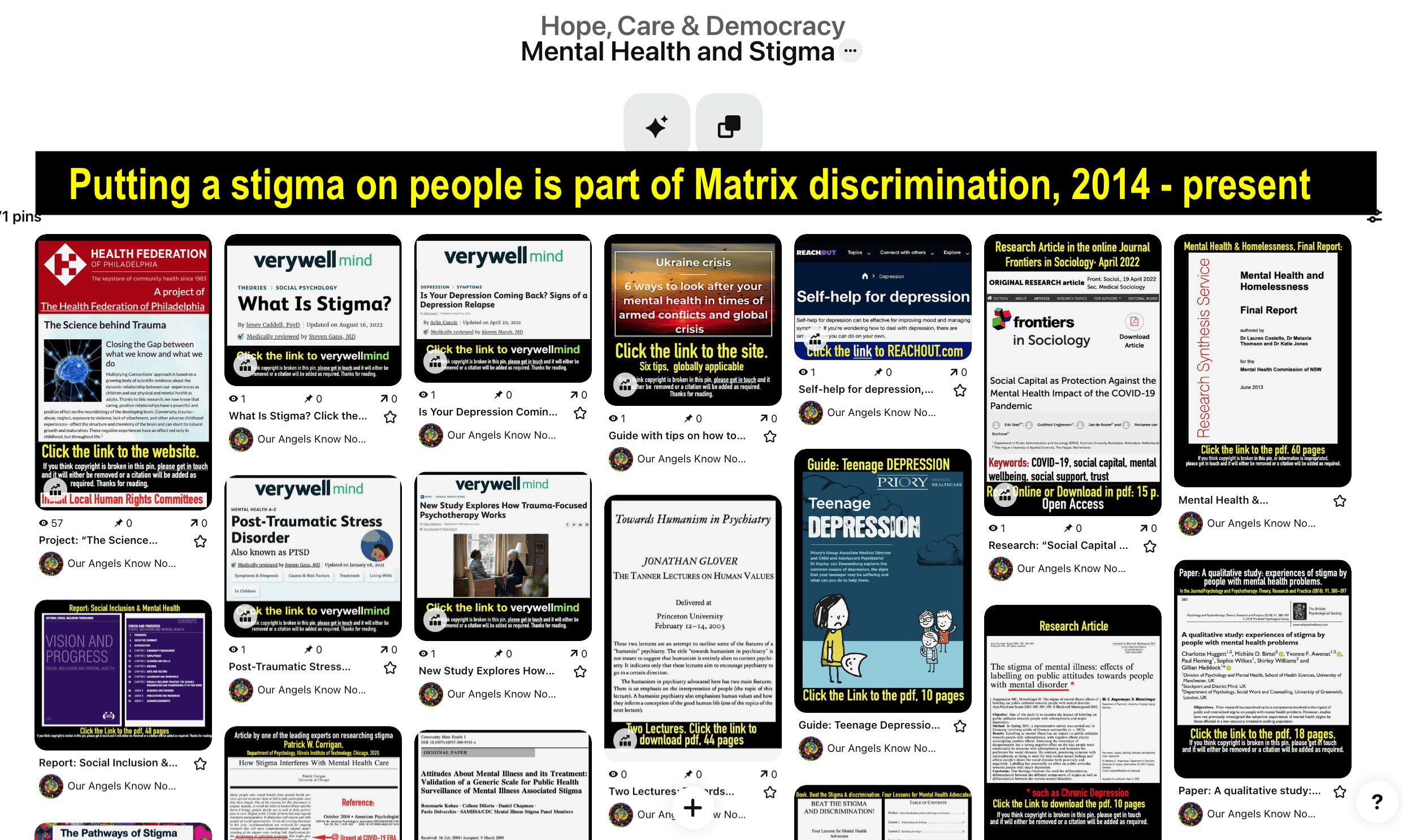
Updated Tuesday, 19 March 2023. Added, collection of papers on stigma and its consequences, scroll to the bottom =>
In this blog you find explanations on:
1. Personality assessments
2. Discrimination
3. Effect of discrimination on mental health and personality traits
1. PERSONALITY ASSESSMENT
What is a personality assessment? Translation of the Belgian organisation PsychPunt
A personality assessment is a form of psychological research in which we assess your personal functioning. This can be requested for adults. Sometimes we invite confidants along if appropriate. A personality test can be an extension of your consultation with a doctor/psychiatrist. Only the doctor/psychiatrist can make a diagnosis. We make a diagnostic consideration.
How do you feel? What characteristics characterise you? How do you deal with emotional events and tensions? How do you react when under stress? How do you function in relationships with other people? Is there a particular symptomatology? A particular pattern in your functioning, in your behaviour? Do we need to make a diagnostic consideration? Is there a particular disorder, pathology? How do you experience others, your family, your work environment, your school? These are some of the questions we answer during the examination. According to your age and your concern, we look at which personality questionnaires we use. We also observe you and conduct a clinical interview in which we listen to your motivation, your objective, your doctor/psychiatrist’s question, etc.
A personality assessment helps you better understand your own behaviour, learn more about yourself and find the right approach where necessary. We always relate the results of the assessment to your age and your wider context in which you live.
For which questions?
A personality assessment may be indicated if you are worried about the following issues:
*your own behaviour (withdrawal, rebellious, certain patterns of reaction)
*depressed mood
*fears
*sleep problems
*brooding, coping with stress
*relational, social problems (dealing with others)
*…
Duration of the examination
At your request (and/or that of the referrer) or if it appears from the introductory interview that this examination is appropriate, we recommend a personality test. Depending on your request, the examination can vary between 1 and 3 hours or can be spread over several test moments. Personality testing can exist on its own, it does not necessarily always follow further counselling or therapy.
Consultation after the test
The tests are scored, processed and a report is drawn up with all relevant information. During the follow-up discussion, we reflect on the personality profile that emerges. We look at the results, the descriptions and whether this matches how you perceive yourself? Taking into account your past history and your current functioning within your broader context (family, work, school), an advice is formulated. You may be able to move on after the counselling session, with a lot more self-knowledge. Depending on how long your concerns about your functioning have been present and what emerges from the examination, individual therapy or short-term counselling may also be proposed. Or in consultation with your referring doctor/psychiatrist, medicinal support may be offered (where the doctor makes a diagnosis).” End quote.
2. DISCRIMINATION WHAT IS IT?
I translated the text in this hashtag

WHAT DOES THE LAW SAY ABOUT DISCRIMINATION AND EQUAL TREATMENT?
“Article 1 of the Dutch Constitution states that everyone in the Netherlands must be treated equally in equal cases. You may not discriminate because of religion, belief, political affiliation, race, gender or on any other ground. In addition, there are specific laws that protect our equality.”
Equal treatment laws
Article 1 of the Dutch Constitution primarily addresses the government. But discrimination between citizens is also prohibited. Both types of discrimination are regulated in the following equal treatment laws:
- Human Rights Board Act
- General Equal Treatment Act
- Equal treatment on grounds of disability or chronic illness Act
- Age Equal Treatment in Employment Act
- Equal Treatment of Men and Women Act
- Difference in Working Hours Act
- Distinction Between Fixed and Open-ended Hours Act
Act on the Human Rights Board
On 1 October 2012, the Human Rights Board Act (WCRM) entered into force. This Act established the Human Rights Board. The Act defines the tasks, powers, composition and working methods of the College. The College issues rulings on discrimination and monitors human rights in the Netherlands.
View the full text of the Human Rights Board Act.
General Equal Treatment Act
The General Equal Treatment Act (AWBG) offers protection to people who are discriminated against on grounds of: *religion/belief
*political persuasion
*race, origin
*gender: male, female, transgender (transsexuals, transvestites, intersex persons)
*pregnancy
*nationality
*heterosexual, homosexual or bisexual orientation
*marital status: married or unmarried, registered partnership or not
You can only invoke protection of the AWGB if it concerns discrimination in the following areas:
Employment
For example, how you are treated at work, in recruitment and selection, mediation, dismissal, conditions of employment and promotion. This includes employees, job applicants, volunteers, temporary workers, on-call workers and interns.
Goods and services
For example, in the areas of housing, welfare, healthcare, culture, education, financial services, insurance services, shopping, sports and entertainment. This includes consumers, patients, students, pupils and apprentices.
The liberal profession
For example, freelancers and self-employed workers.
Trade union or professional association membership
Social protection
For example, in the case of benefits or study financing. This applies to people who feel that a distinction has been made on grounds of race in social protection.
View the full text of the General Equal Treatment Act.
Equal treatment on grounds of disability or chronic illness Act
The Equal Treatment on the Grounds of Disability or Chronic Illness Act (WGHB/CZ) provides protection to people discriminated against on the grounds of disability or chronic illness. The law makes it mandatory – if requested – to make effective adjustments for people with disabilities or chronic illnesses. All long-term physical, mental and psychological disabilities are covered by this law. You can only invoke this law if there is discrimination in the following areas:
Employment
For example, how you are treated at work, in recruitment and selection, mediation, dismissal, conditions of employment and promotion. This includes employees, job applicants, volunteers, temporary workers, on-call workers and interns.
The liberal profession
For example, freelancers and self-employed workers.
Membership of trade unions or professional associations
Vocational education
For example, in practical education and at MBO, HBO and university courses. This includes pupils, school pupils and students.
Primary and secondary education
This applies to pupils and students.
Housing
This applies, for example, to tenants and buyers.
Public transport
This applies to train, bus and metro passengers, among others.
Goods and services
For example, housing, welfare, healthcare, culture, education, financial services, insurance services, shopping, sports and entertainment. This includes consumers and patients.
View the full text of the Equal Treatment on Grounds of Disability or Chronic Illness Act.
Age Equal Treatment in Employment Act
The Equal Treatment on Grounds of Age in Employment Act (WGBL) offers protection to people who are discriminated against because of their age, for example because they are seen as ‘too young’ or just ‘too old’. You can only invoke this law if there is discrimination in the following areas:
Employment
For example, how you are treated at work, in recruitment and selection, mediation, dismissal, employment conditions and promotion. This includes employees, job applicants, volunteers, temporary workers, on-call workers and interns.
The liberal profession
For example, freelancers and self-employed workers.
Membership of trade unions or professional associations
Vocational education
For example, in practical education and at MBO, HBO and university courses. This includes pupils, school pupils and students.
View the full text for the Age Equal Treatment in Employment Act.
Gender Equality Act
The Equal Treatment of Men and Women Act (WGB) deals with the difference in treatment between men and women at work. An employer may not discriminate when entering into an employment contract, terms and conditions of employment, working conditions, promotion and dismissal. Both male and female employees can invoke this law. For example, if your male colleague earns more than you while doing the same job.
See the full text of the Gender Equality Act.
Working hours act
The Distinction in Working Hours Act (WOA) came into force in 1996. The Act prohibits a difference in treatment between part-time and full-time employees at work unless there is an objective justification for this. Both full-time and part-time employees can invoke this law if they are treated unequally in the conditions under which an employment contract is entered into, continued or terminated.
View the full text of the Differentiation of Working Hours Act.
Act on the distinction between fixed and indefinite duration
The Act on the Distinction between Fixed and Open-ended Employment (WOBOT) prohibits a difference in treatment between employees with permanent employment contracts and employees with temporary employment contracts, unless there is an objective justification for this. You can invoke this law if your employer treats you differently from other employees in the conditions of employment.
See the full text of the Differentiation between Fixed and Permanent Employment Act.
End translation of the Dutch National College of Human Rights on equality
3. EFFECTS OF DISCRIMINATION ON MENTAL HEALTH
Translation of the Dutch Knowledge platform inclusive cohabitation.=> KIS.NL

Experiencing discrimination is associated with poorer physical health and especially poorer mental health. This is reflected in several studies. Specific research has also been done abroad on discrimination towards children. Experiencing discrimination as a child, is often associated with experiencing poorer health among children and with more externalising problem behaviour such as violent or delinquent behaviour. Discrimination is therefore not only harmful to the victim himself but can also have negative effects on those around him.
Physical and psychological harm
There is even less research available in the Netherlands, but the research that is available shows that discrimination is also bad for health in the Dutch context. For instance, a Dutch study among young adults of Moroccan origin showed that perceived discrimination and perceived social failure were significantly linked to depressive symptoms. Recently, Oneworld drew attention to the topic and to Umar Ikram’s PhD thesis (2016) showing that ethnic minorities in the Netherlands also experience a lot of discrimination and therefore suffer and will suffer more from psychiatric complaints and cardiovascular diseases. That discrimination is bad for health and well-being seems to be true not only when it comes to discrimination based on origin or skin colour but also on sexual preference and gender identity. It is known that lesbian women and gay men are more likely to suffer from mental health complaints than the rest of the population. Among other things, experiencing negative reactions is a factor predicting poorer health for gay men and lesbian women. And 73 per cent of transgender young people, a small sample shows, experience mental health problems.
Stress and tension
That discrimination leads to poorer health is because experiencing it leads to stress and tension, which in turn affects health. This is also the rationale of a well-known scientific model: the minority stress model. This model is particularly applied to LGBTTI people but can also be used when it comes to people who are a minority because of their ethnicity or skin colour. The model predicts that minority people’s health gets worse if, among other things, they (1) experience discrimination, (2) fear discrimination and (3) see themselves as inferior to people who are in the majority.” End translation of the Dutch Knowledge platform inclusive cohabitation.=> KIS.NL

Hashtag Canadian Mental health Association
