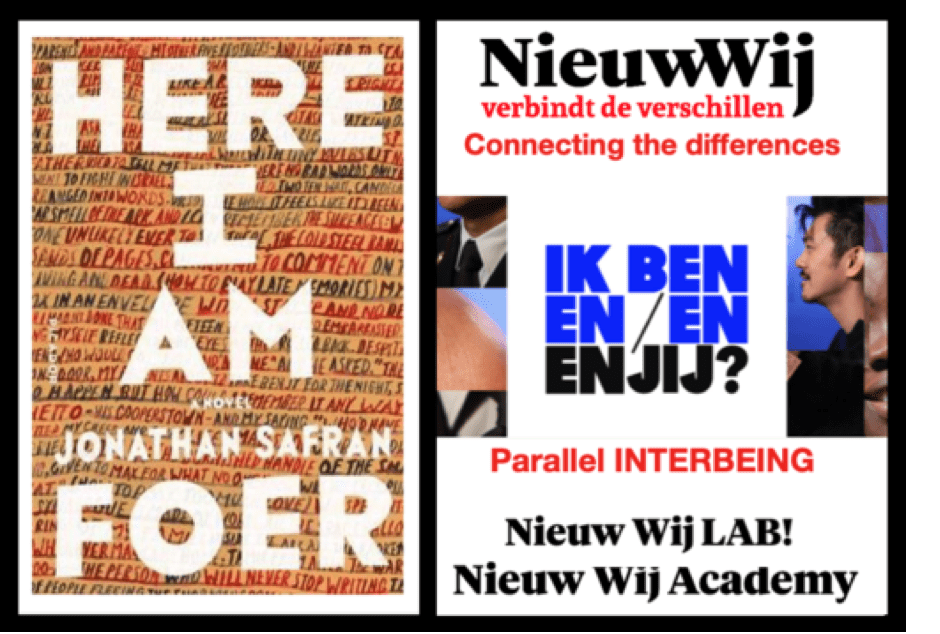
My review about the novel Here I Am by Jonathan Safran Foer was published December 4th 2016 in the online Magazine “NieuwWij” (New Us), part of a social cohesive Dutch parallel* initiative, founded by Manuela Kalsky and her friends in 2016.
Statement / Objective NieuwWij: “Nieuw Wij wants to connect the differences and contribute to a society in which everyone feels at home. Nieuw Wij achieves this by signaling and putting on the agenda current social developments and by asking the right questions, both via our online platform and in the services we offer.”
Basic principles: NieuwWij has two main activities:
- Maintaining the multimedia platform Nieuwwij.nl in which a wealth of articles, interviews, videos and information can be found about making connections between different groups in society.
- The realization of educational projects and consultancy services about diversity and the dilemmas in a culturally and philosophically diverse society. For this purpose, the foundation uses the labels NieuwWij Academy and NieuwWij Lab.
The NieuwWij Academy Statement: The New We Academy is there for young and old. For those who would like to learn to find a meaningful place in our super-diverse society. And if you would like to grow in connection with people who are very different from you. The Nieuw Wij Academy challenges you to think about your values. About your identity in relation to that of others. About your vision on major themes of the future. About your sense of belonging.
The NieuwWij Lab Statement: The New We LAB project focuses on the question of how we can tackle discrimination in society effectively and with sufficient support. We focus on addressing and activating the large middle group in an accessible way. There are many professionals, from government to education, from media to social organisations, who are committed to reducing polarisation and discrimination. We put these people in the picture in the Nieuw Wij LAB project on nieuwwij.nl.
*Parallel: synchronic online and offline social cohesive initiative.
Translation into English of my Dutch review
[…]…I advice you to read the book Here I Am, first, before you read this review! It is not a ‘good’ review, it is an idiosincratic review! SORRY!
To Mr. Jonathan Safran Foer I would like to say. Sir, thank you for writing it. I am very sorry if my review does not reflect your intentions. I swear. Also..I would like to state that I think that the difference between atheïsts and people who have religious views stems from similar thought patterns. They do not have to cause disruptions in interpersonal communications.
In his third novel, Jonathan Safran Foer (1977) examines the identity development of the individual in a globalising, disruptive society.
Jacob, one of the main characters in Here I Am, states that he is smaller than life. With his cousin Tamir, he recalls their childhood adventure that took place in the Washington DC Zoo. Like the biblical Daniel, Jacob ends up in a lion’s den. The remark reflects a key life experience of the main character. In the lion’s den, Jacob felt surrounded and embraced by his own existence. He felt, perhaps for the first time in his life, safe.
Jacob’s sense of security contrasts with the Biblical reference of the book title Here I Am. The Genesis story of Isaac’s sacrifice is famous across cultures and intertwined with Judaism. God the Father calls, ‘Abraham’, who answers, ‘Here I am’. Abraham does not say to God, ‘What do you want?’, or, ‘Just a minute, I’ll be right there.’ He answers, ‘Here I am’, unconditionally, without wavering, without reserve, he reports his presence, whatever God may ask of him. Later, as Abraham ascended Mount Moriah with his son Isaac, Abraham consoled his troubled son with: ‘Here I am.’ Abraham’s double loyalty vow gives him a paradoxical identity. Abraham cannot be present for Isaac as a protective father when God simultaneously asks him to sacrifice his son. Safran Foer uses this moment in the Bible story as a model for the identity development of the main characters in his book.
Here I Am describes a month in the life of Jacob, a 43-year-old TV scriptwriter. He lives with his wife, 42-year-old architect Julia, and their three sons Sam, 13, Max, 11, and Benjy, 6, in Washington DC. Argus, the elderly, incontinent family dog completes the family. Jacob and Julia are initially absorbed in their marriage, but Julia’s discovery of an unknown mobile phone in the house leads to a crisis in which the question arises for both: ‘Am I in or out of this marriage?’ They become lost in their marriage, alienated from themselves and from each other. They feel forced to make new choices. Here I Am interweaves inner lives with outer behavior. Domestic crises are flanked by a world crisis. An earthquake in the Middle East results in a war that forces the Prime Minister of Israel to call on all Jews between 18 and 55 in the world to come to Israel and defend the country.
The disaster in the Middle East takes place during Tamir’s visit to Washington. News from parts of the region where satellite connections still work seeps in via radio, TV and the Internet. Tamir’s family members, who had stayed behind in Israel, witnessed it first-hand, and the faltering telephone connections made Tamir anxious and emotional. His son goes into service to defend Israel against the surrounding enemies. The conversations about this between Tamir and Jacob in Washington appeal to Jacob’s Jewish identity. Their dialogue unfolds different ways of experiencing and shaping this. Safran Foer’s strength lies in demonstrating argumentative search. Jacob says in conversation with Tamir: ‘I am always tired. Constantly worn out. I never asked myself this before, but what if I wasn’t really tired all the time? That my tiredness is actually a hiding place.
Closeness in relation to identity development is an important theme in this layered and rich novel. It is also a precarious topic in our globalising society. The influence of the virtual world on the closeness of ‘interbeing’ changes its significance. The French geopolitical thinker Dominique Moïsi (1946) emphasises the role of identity in relation to the emotions hope, fear and humiliation. These three sentiments influence the relationship with ourselves; our own inner self and with others, both at a distance and close by, online and offline, in the actual state of parallel ‘interbeing’. The impact of the three sentiments on thought-patterns colour the family relationships in Here I Am.
How does it help if we become aware of the underlying emotions of our thinking? Are we thereby better able to analyse our identity, transform it and subsequently tolerate and integrate that of others, so that instead of conflict, we strive for harmony? In Here I Am, Safran Foer continually explores these two questions with playful seriousness. They shape Jacob’s Jewish identity from three angles. First, from his self-analyses, such as during a marital quarrel after Julia discovers Jacob’s explicit text messages to his female colleague. Julia snickers about their dog Argus ‘…is smarter than my husband.’ For the first time in their marriage, this leads to a scream from Jacob to Julia: ‘It was a scream that had accumulated in him over sixteen years of marriage […] a scream directed to her, but also to all others, dead and alive, and first and foremost to himself. For years he was somewhere else, always underground behind a door thirty centimeters thick, always fleeing in an inner monologue that nobody – not even he – could reach […] this was him. Jacob is shocked by his own scream, by this unexpected, never before consciously expressed aggressive behavior towards Julia.
Secondly, Jacob’s identity development is influenced by his fatherhood. He experiences feelings and thoughts that he did not know before and that arise from the daily presence of his children. In response to a heart-wrenching war-related news story about a girl named Adia, Jacob says: ‘[…] like everyone’s heart, mine too is limited, and if I had to choose between Adia and Benjy (his youngest son), I would snatch the food out of her hands and give it to Benjy. I am not going to argue that this is good or fair. I am just saying that it is not bad, because it is not a choice. Jacob discovers that it is impossible for him to love a girl in need who is unknown to him as much as he loves his own children.
Jacob’s identity development is thirdly determined by his love affair. He and Julia struggle to narrow the gap between who they have become together and who they thought they wanted to become. There are constant frictions between their inner lives and what happens to that loved one in close proximity. Where do they want to be open to ideas and feelings that blow in unexpectedly and unannounced, and where do they want to close themselves off? Is it advisable to practice gratitude for what is, in the everyday security of your ‘small’ intimate environment with family and friends? How do you learn not to get carried away by the ‘news waves’ brought by the virtual media, such as the creation of a moral duty to help displaced strangers, to pursue nicer jobs, to make different choices in everything that comes up? How to find a way in this that fits with who you want to be and become? In a conversation Jacob and Julia have with the rabbi about the imminent suspension of their eldest son Sam’s bar mitzvah, because of a racist note attributed to him, we read: ‘The rabbi interwove his fingers, just like a rabbi, and said, “There’s a Hasidic proverb: “While we pursue happiness, we flee from contentment.”‘ Jacob rose, folded the paper, tucked it in his pocket and said, ‘You’ve got the wrong guy.’
This is Jacob all over. He becomes aware that self-development, the process of becoming who you want to be, for yourself, your lover, your children, your family, your colleagues, never stops as long as you live. Here I Am ingeniously weaves an intimate quest for identity development into a family history, affected in the background by a geopolitical event. The developments in the relationships between Jacob, Julia, the children, family and, last but not least, dog Argus, are described with humor, give goose bumps, are moving and give insight, because they make you look in a new way at yourself, your relationship with your own loved ones and what you pick up daily from the ‘bigger’ elusive world that enters via radio, TV, mobile and internet. Here I Am is a must read for all of us who want to continue to develop and invest in the security of a larger world with others alongside us.
You can order Jonathan Safran Foer’s book Here I Am in this link.
********
Cora Westerink (1965), alumna Tilburg University and Arts Academy
