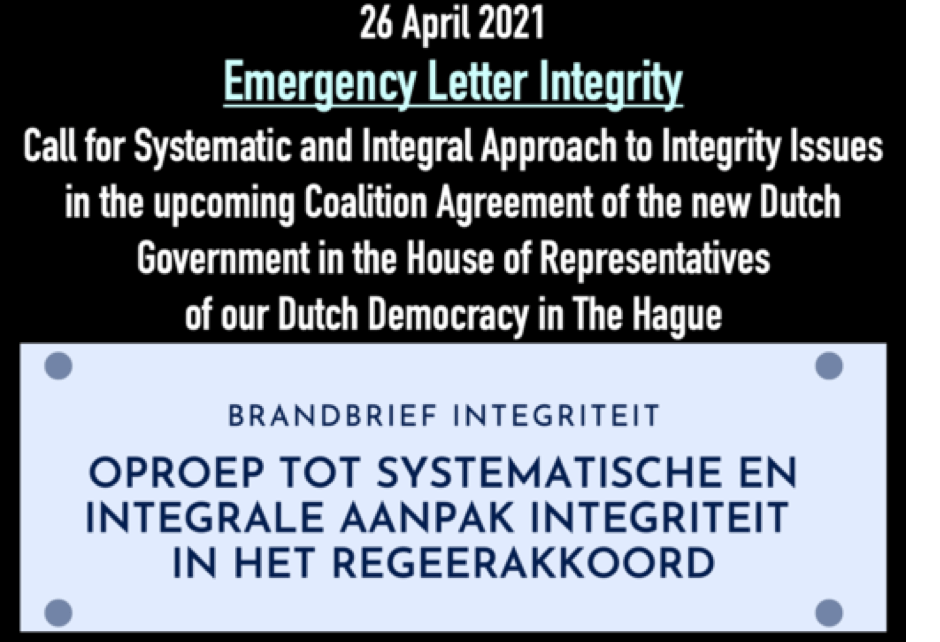
The Dutch Parliament is called the States General. It consists of two chambers: the Senate and the House of Representatives. On the initiative of the chairmen of the Dutch Network Good Governance, more than 30 integrity experts from research, the policy field and socially involved organisations sent an emergency letter to the House of Representatives and the States General on 26 April 2021. In doing so, they call on the then upcoming cabinet to take a systematic and integrated approach to integrity issues in the public domain.
26 April 2021
Emergency letter integrity public governance and administration
p/a: Parliament of the States General
For the attention of the informer, Mr H.D. (Herman) Tjeenk Willink, the Speaker of the House of Representatives, Ms V.A. (Vera) Bergkamp, and the parliamentary party chairmen of the Parliament of the States General.
P.O. Box 20018, 2500 EA The Hague
Quote: “The integrity of public administration stands or falls with its governance, and a breach of the integrity of government means nothing less than that the government loses the trust of the citizens. And without that trust of the citizens, democracy cannot exist. Then democracy has died. That is an oppressive picture.” Ien Dales (1992)
Dear informer, chairman, political group chairmen,
With this open letter we, united in the Network Good Governance, address ourselves through you to the upcoming cabinet with an appeal to initiate and perpetuate a more systematic and integral approach to integrity issues in the public domain. The need is great, and the shared sense of urgency high. Fed by our commitment, experience and expertise in the field of integrity, we are pleased to share our collective vision and recommendations with you.
Despite the increase of integrity policies and measures in public organisations, public administration is still confronted with integrity violations, as the numerous examples in the Political Integrity Index* and the recent case of the Province of Limburg show. These integrity violations take place at all levels and in many different forms.
The ongoing series of affairs is not an isolated case, but is symptomatic of a system that is gradually undermining the quality of public services as well as the credibility of and trust in the government. As the late Ien Dales already stated in the 1990s, integrity is not an afterthought in political and official dealings but the foundation on which good governance and the democratic system are built. Moreover, a respectful and transparent relationship with citizens and companies is simply a cast-iron business model. Yet for years, the sustainable anchoring of integrity has been insufficiently placed on the political agenda.
Why must we act now?
The call for a different administrative culture is stronger and more widespread than ever before. The government is expected to do the right thing, even when nobody is looking. The House of Representatives in The Hague, civil servants and citizens are calling for an honest, reliable and trustworthy government with more transparency and openness, but also more dialogues, and room for professionalism. At the same time, developments and policy changes surrounding active disclosure, the implementation of the new EU Whistleblower Directive, the benefits affair and the Temporary Committee on Implementing Organisations are forcing far-reaching reflection on the moral considerations that the government makes and the way in which the integrity system is organised.
In other words, there is both a need and an opportunity and momentum to set real change in motion. To restore integrity as the foundation of our democracy. If we let this window of opportunity pass us by and fall back on old patterns, cynicism among citizens and civil servants will only increase and strengthen the downward spiral of distrust. Therefore, to protect our democratic legal order, it is crucial right now that the anchoring of integrity is given an explicit place and further elaboration in the new government programme.
Why is the current approach not satisfactory?
Throughout the country, civil servants, integrity officers, scientists and NGOs work tirelessly behind the scenes to stimulate and guard the integrity of public administration. But the integrity system is fragmented and lacks institutional embedding and clout. There is ad hoc decision-making on integrity policy and construction faults in the formal systems that should safeguard the integrity of the government. What has been arranged often falls short due to inadequate implementation, insufficient translation to personnel policy and organisation systems, and too little time, space and means to pay attention to integrity in primary processes. Moreover, because of the excessive focus on the individual behaviour of people, there is little eye for the moral consequences of policy choices and institutional actions.
Because of the way in which the current approach is set up, signals and alarm bells are often ignored for too long and attention to integrity in government remains passive and reactive. The political reflex of lying, covering up, evading and circling around is fatal. We only pay attention to it when things really go wrong. If the government refrains from action, it accepts the damage that the lack of anchoring of integrity causes to our democratic legal system, to the trust in the government and to citizens. It will then maintain a public system that operates too much at the limits of propriety. That is unacceptable.
What is needed to better embed integrity?
Our starting point is simple: a more proactive and systemic approach is crucial. It is time for an integral approach in which we explicitly connect the individual, situational, organisational and social factors that influence integrity risks and embed measures more broadly and more institutionally. In which political and administrative integrity are viewed in conjunction with each other. And where we no longer see breaches of integrity as ‘incidents’ that only say something about the moral compass of an individual civil servant or politician, but as crucial lessons about the role and responsibility of the collective and the systems in which those civil servants and politicians operate.
More concretely, based on our collective involvement, experience and expertise, we advise the government to manage and supervise:
*A more design-oriented approach to integrity policy, both at the national level and in organisations. Integrity policy is often fitted on top of and within existing systems. The result is a confusing whole of instruments, measures and reporting channels that has little coherence, little protection and is far too remote from the working practice. An effective integrity system requires the courage to critically examine existing systems and, where necessary, make structural changes to the public system and government organisations. Only then can integrity really get the place it deserves. The increasingly popular instrument ‘design thinking’ can be helpful in this.
*The systematic securing of the implementation and execution of integrity policy through leadership development. Integrity policy is often still too far removed from the work floor. Leadership is needed to implement integrity policy in daily practice and to link it to primary work processes and current developments. This requires leaders who not only set a good example, but who are also capable of actively stimulating moral reasoning, acting with integrity, social and psychological safety, dissent, diversity and inclusion. The skills that this requires are not self-evident and require appropriate personnel policies and embedding in management development programs and ABD pathways, and sufficient time, space and appreciation for ethical leadership.
*The systematic safeguarding of a culture of accountability, transparency, and psychological safety. To act with integrity, it is essential to recognise and acknowledge different perspectives and interests, and to be able to explain moral considerations. Therefore, organise and value the contradiction that keeps us alert to moral risks and blind spots. And safeguard that contradiction by not going overboard with transparency: extreme transparency undermines psychological safety and is counterproductive. Build on trust and invest in the moral consciousness within the government. Look at how the desired behaviour can be stimulated and whether the system in which one works is correct. Also invest in a safer reporting culture by offering real protection to whistle-blowers and providing them with financial, psychosocial and legal support. Give confidential counsellors, integrity officers, inspectorates and the Whistleblowers’ House a stronger position in the system and equip them with adequate resources. Finally, build a government in which technical rationality that has gone too far and a short-term focus on results make way for sufficient reflection and consideration of professionalism3 in the civil service, good governance and the public task. This will benefit the efficient, effective and honorable performance of tasks in the long term.
*Embracing critical voices at the institutional level. Institutional checks and balances only work by the grace of a government that really takes them seriously. All too often, signals from European and national institutional countervailing forces are brushed aside, pacified or simply ignored. Therefore, pay more attention to following the recommendations of, amongst others, the Parliamentary Inquiry Committee on Childcare Allowance, the Temporary Committee on Implementing Organisations, the National Ombudsman and local ombudsmen. Furthermore, invest in the institutional checks and balances themselves. Not only by paying more proactive attention to the moral awareness and behavior of ministers and members of parliament, but also by equipping the Lower House with the information and support it needs to properly perform its supervisory role.
*A stronger connection to European rule of law. In order to be able to call other Member States to account in the context of Europe for the threat to the rule of law due to poor integrity and corruption, the Netherlands itself must take a look in the mirror and guarantee the importance of the rule of law much more emphatically. More than is currently the case, the Netherlands must fully comply with European standards in the area of integrity and embed them permanently in national legislation. The minimal implementation of, for example, the EU Whistleblower Directive or recommendations from the UN, the Council of Europe (GRECO) and the OECD is not enough. The Netherlands must at all times stand up for the rule of law in Europe and ensure that integrity is placed high on the agenda in their own country. This means: building on trust and preventing the Netherlands from getting bogged down in a reputation for tax benefits and lobbyism that seriously threatens to undermine the integrity of the Dutch government, our business community and trade. Dare to take the lead internationally in the field of integrity and show that transparency and openness go hand in hand with effective government action and are prerequisites for an attractive investment climate and a flourishing business community.
*Explicit reassessment of political-administrative relations. Facilitate the collective discussion about the political-administrative relationship and the corresponding administrative style. Periodic, constructive reflection on the content of the relationship between politicians and civil servants stimulates critical awareness and coordination of the various roles, role perceptions and mutual expectations between politicians and civil servants. This puts both parties in a better position and increases the security, mutual understanding and trust that is needed for loyal contradiction and the prevention of improper influence. An effective integrity system cannot exist without it. We have to move from a culture of passing the buck to a culture of addressing others. We must keep our finger on the pulse of how policy unfolds, based on the broad knowledge and professionalism of the practitioners. And we must provide civil servants with frameworks in their daily work in which the public values they pursue and of which they are proud are actually reflected in a recognisable way. In this way, moral dilemmas and risks can be detected in time and, in consultation with them, an adequate and workable solution can be found.
Almost thirty years after Ien Dales made a penetrating plea for more fundamental attention to the integrity of the government, her words seem more urgent than ever. The crumbling of our democratic legal order must be stopped. If we do not seriously invest in a systematic and integral approach to integrity, we will undermine the foundations on which our society is built. With this letter, we urge your attention to this issue and call for the intensification of efforts in this field in the coming legislature.
Yours sincerely,
The chairmen of the Network Good Governance
Prof. Dr. L.W.J.C. Huberts (Emeritus Professor of Public Administration, VU University Amsterdam) (leader)
Prof. G. de Graaf (Professor of Public Administration, VU University, Amsterdam)
Dr. L. Heres (Associate Professor of Public Administration and Organisational Science, Utrecht University)
Dr. H.L. Paanakker (Lecturer in Public Administration, Radboud University)
Prof. Z. van der Wal (Ien Dales Professor, Leiden University)
*The Political Integrity Index (PII) is a project by Leo Huberts (emeritus professor of public administration at the VU University Amsterdam), Muel Kaptein (professor of business ethics at RSM Erasmus University) and research journalist Bart de Koning. The PII maps integrity violations by Dutch politicians since 1980.
