Reporters: Jeroen Wollaars, Bastiaan Hetebrij & Roemer Ockhuijsen
Transcript by Cora Westerink
Broadcasted 15 April 2022, Dutch NPO 2: 11:15 minutes video
INTRODUCTION This week, children’s ombudswoman Margrite Kalverboer visited the application center for asylum seekers in Ter Apel. She told NRC that she was shocked by what she found there: children were said to be ‘mentally neglected’ and to suffer new traumas in the asylum seekers’ center. Tonight, she is in the studio to talk about her experience and what she thinks needs to change.
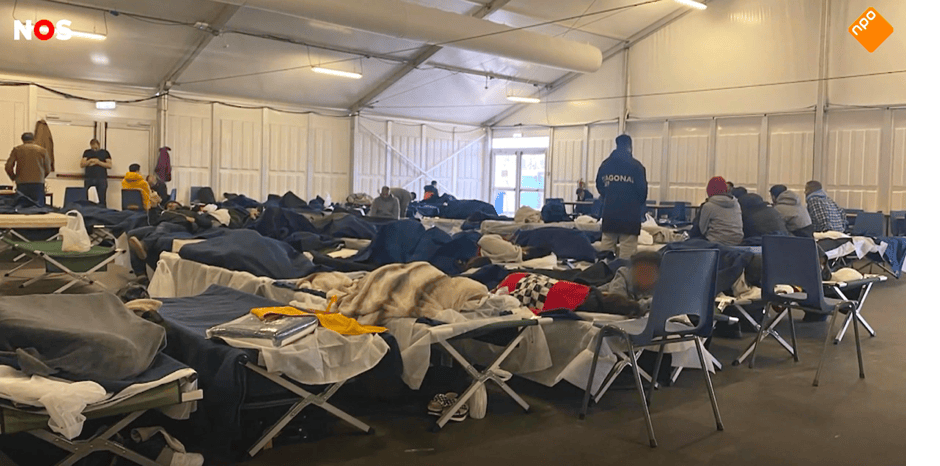
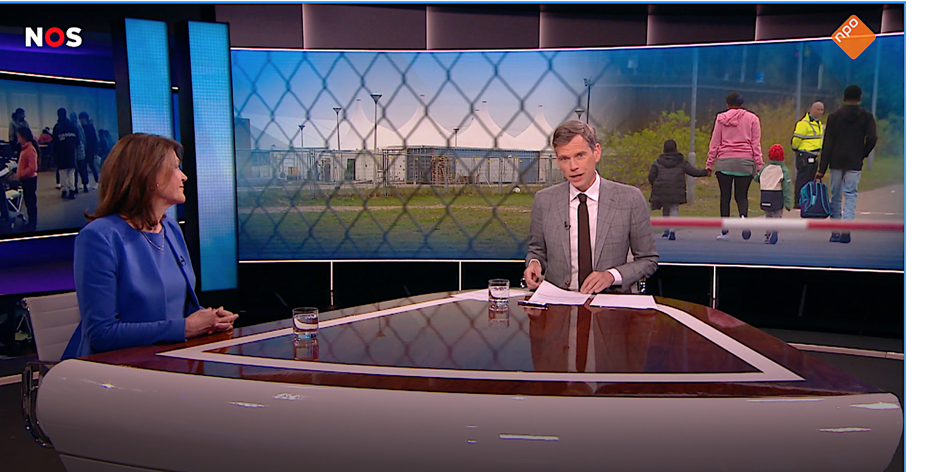
Jeroen Wollaars to Margrite Kalverboer: “Men, women, children. Everyone lives and sleeps on each other’s lips 24 hours a day, sometimes for weeks. This photo was passed on by a refugee because journalists are kept at a distance from the asylum centre. It seems you are not meant to see what it looks like inside. [Who was allowed to look behind the fences is the ombudswoman Margrite Kalverboer, good evening. To be clear, you were not in this tent that we showed you, but at a reception location a little further down the road, where underage, unaccompanied refugees are received. Why did you go there?”
Margrite Kalverboer to Jeroen Wollaars: “I had heard from various organisations that the children there were not doing well and I wanted to see for myself.”
Jeroen Wollaars to Margrite Kalverboer: “What did you find?”
Margrite Kalverboer to Jeroen Wollaars: “Well, I found, different from what we see here in the tents, children who were in nice decent buildings, who were given food and drink, but who, for example, were not woken up in the morning because there was nothing to do. I saw children who were so frightened…. I talked to several children…that was nice. I was able to speak to them alone, together with a colleague who also spoke to some of the children. What the children said, and what they radiated, was that they were incredibly afraid, that they experienced enormous stress. They came to the Netherlands via various escape routes. I spoke with a boy of 16 from Afghanistan. He spoke perfect English and he told me that he had come via Paris, that his phone had been taken there. His sister stayed behind in Afghanistan. His little brother stayed behind in Afghanistan. He said: “I have no phone and I have no watch. When I wake up at night, I don’t know what time it is. I don’t know my sister’s number. I cannot reach her.” […] Then I spoke to supervisors who had already told me, therefore, that I would speak to that boy. They said, “he doesn’t have a phone, so we don’t know what time he’s coming.” […] What I feel in that is, I think, such a boy, who is so absorbed by fear and panic, for him even a watch…he didn’t even ask for a phone…but a watch…so that when you wake up at night, you know, for example, that it’s 3 o’clock and not 5 o’clock in the morning. […] What we always do from the children’s ombudsman organization, we always take a very small present with us to thank the children. […] After the talks, I thought, I think it’s a bit embarrassing what we’ve brought along now. We had a pen, and a notebook, just a simple notebook and all those children were so happy with it.”
Jeroen Wollaars to Margrite Kalverboer: “What is organised for those children there? […] How long are they there?”
Margrite Kalverboer to Jeroen Wollaars: “Nothing […] From, the children we spoke with, between 3 months and 21 days. […] Returning to the pen and notebook. Those boys and girls said: “Now we can at least write down what we feel in our heads”. […] Something so small, even that is not there.”
Jeroen Wollaars to Margrite Kalverboer: “So nothing is organised for the children. They sometimes sit there for months. You called that mental neglect earlier.”
Margrite Kalverboer to Jeroen Wollaars: “Yes, indeed. Any normally functioning child, if you offer them nothing, and you would observe that, you would observe the development of weird behaviour. These children come here after they may have had a very difficult journey, after they may have had to deal with human trafficking, may have been abused, with enormous fears, about how things are going at home? Home, the country they come from. So a lot of stress. All that is in the child’s head. If you don’t have any distractions, if there is nobody who even takes the time to ask you: “How are you?”, then you only develop more problems, up to and including psychiatric problems.”
Jeroen Wollaars to Margrite Kalverboer: “You sound the alarm. We will continue to discuss this in a moment. Also today, State Secretary Van der Burg visited the asylum centre in Ter Apel. Let’s watch the report.”
VIDEO RECORDING OF VISIT by reporters Bastiaan Hetebrij & Roemer Ockhuijsen
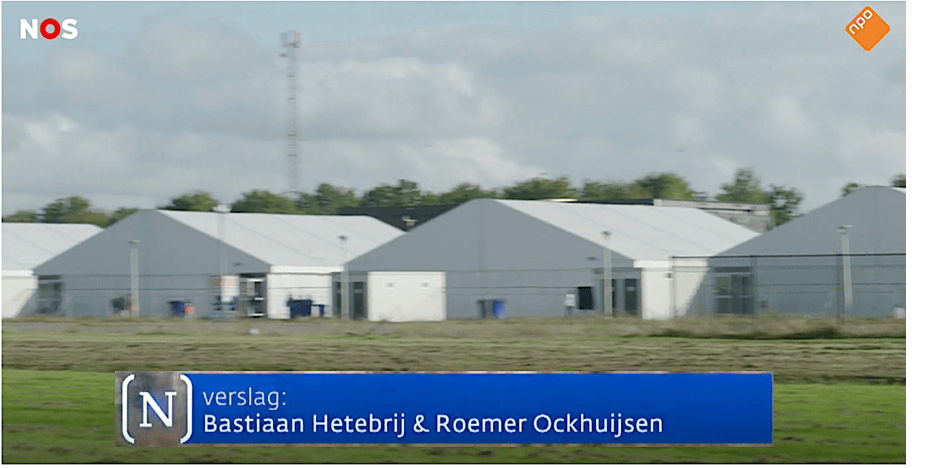
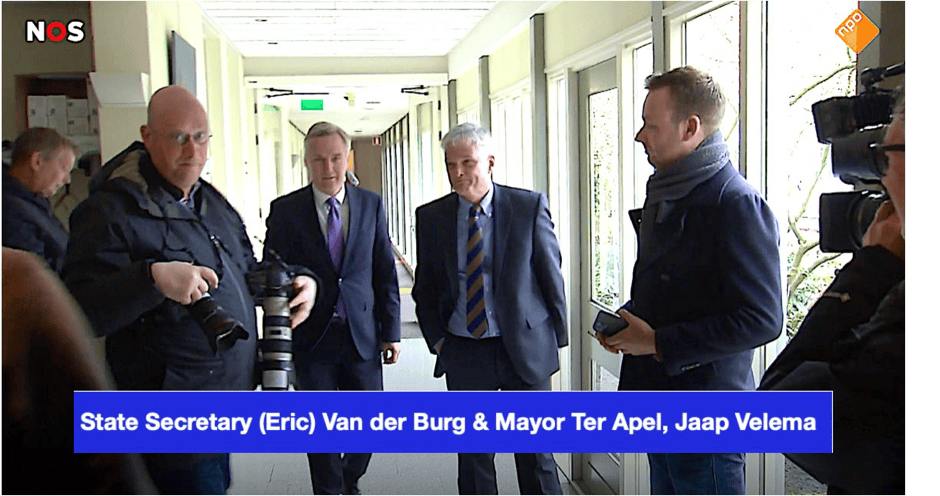
Voice-over Bastiaan Hetebrij & Roemer Ockhuijsen to the viewer: “Ter Apel has been complaining for months about the overcrowded application centre for asylum seekers. It is so full that COA built extra tents, so-called pavilions. This morning, there was another consultation about these problems. Consultation between the State Secretary and the troubled mayor. He now got his way, because those tents are being pulled down.”
Bastiaan Hetebrij & Roemer Ockhuijsen to Mayor Jaap Velema (D66): “I can also imagine that people say: “Leave those pavilions, at least we’ll have some extra space.”
Mayor Jaap Velema (D66): “If we had left the pavilions standing today, we could have added another 2, 3, 4 or 5 pavilions tomorrow. That is the situation in the Netherlands at the moment, because there are too few municipalities that are prepared to take their responsibility. That is why we had to draw a line in the sand, with pain in our hearts, because you can see that this is creating an impossible situation.”
Voice-over Bastiaan Hetebrij & Roemer Ockhuijsen to the viewer: “The State Secretary also took a look himself. Repeated requests to other municipalities to accommodate more asylum seekers have so far had little success.”
Bastiaan Hetebrij & Roemer Ockhuijsen to State Secretary Eric Van der Burg (VVD): “Will you resort to coercion if things do not work out?”
State Secretary Eric Van der Burg: “The moment we include it in the form of a law, there will also be a form in which someone will say: “Municipality, you must now regulate places.” That may be the mayor, that may be the province, that may be the state.”
Voice-over Bastiaan Hetebrij & Roemer Ockhuijsen to the viewer: “At the application centre, meanwhile, opinions differ as to how things are arranged inside.”
.
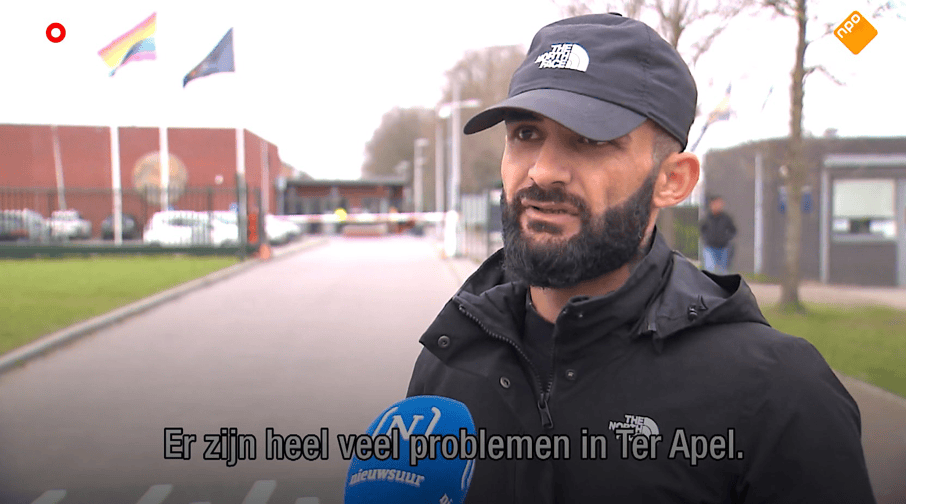
Asylum seeker in Ter Apel to the NewsHour reporters: “There are many problems in Ter Apel, not good. The Netherlands, a very good country, but Ter Apel, problems.”
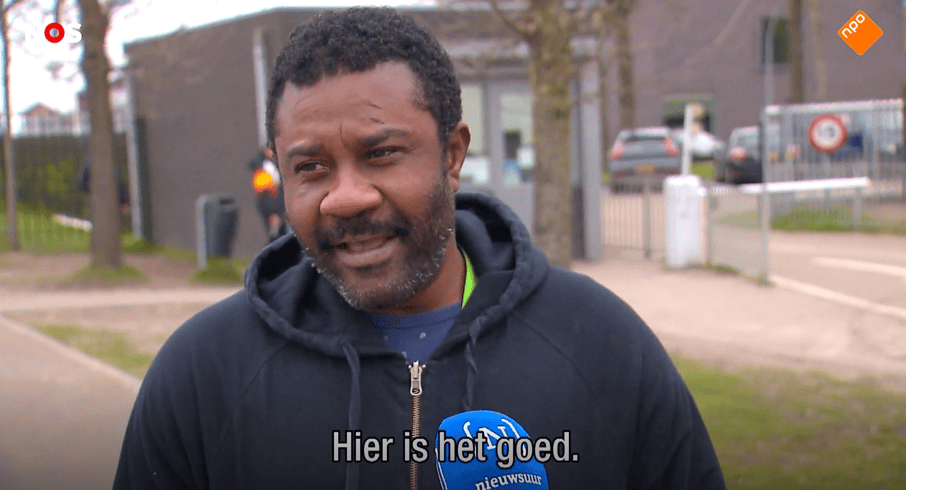
Asylum seeker in Ter Apel to the NewsHour reporters: “It is good here in Ter Apel.”
Voice-over Bastiaan Hetebrij & Roemer Ockhuijsen to the viewer and to another asylum seeker: “One of the men lives with his children in such a pavilion, (like this gentleman). Sir, what is it like in there?”
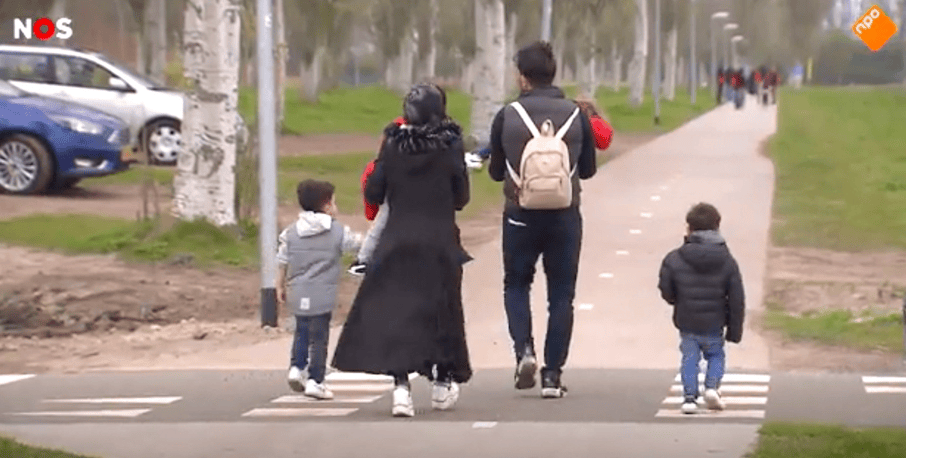
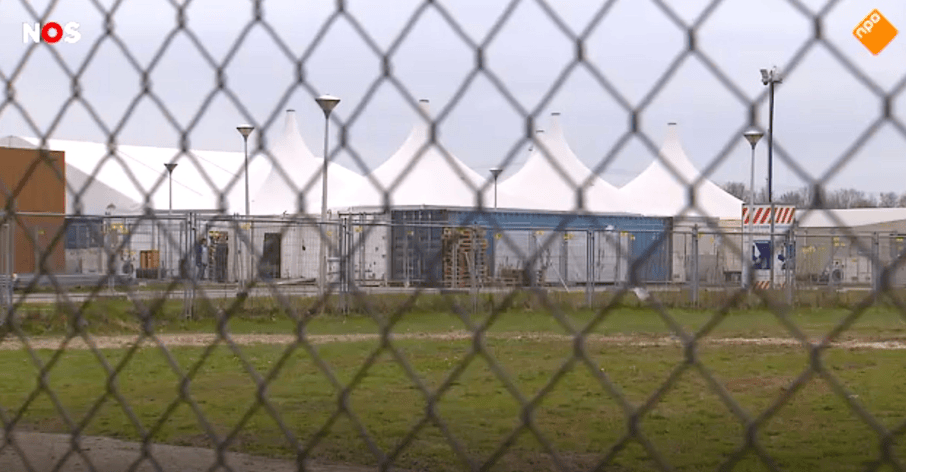
Asylum seeker in Ter Apel to the NewsHour reporters: “There is nothing, absolutely nothing there. We live with about 100 people in a tent. We have no room of our own.”
Voice-over Bastiaan Hetebrij & Roemer Ockhuijsen to the viewer & mayor: “Fortunately for this father and his family, the tents are being dismantled. But the COA (Central Reception Coordination Centre for Asylum Seekers) says that they have no idea yet where all the asylum seekers will go next Tuesday. No wonder, then, that the mayor does not quite believe it yet.”
Mayor Jaap Velema (D66): “Given my experiences over the past few months, I am not yet completely out of the woods. We really need to put our money where our mouth is.”
Voice-over Bastiaan Hetebrij & Roemer Ockhuijsen to the viewer & to State Secretary Eric Van der Burg: “Then there is the criticism of the Children’s Ombudswoman. Over 100 unaccompanied young people are living in poor conditions in this centre. The State Secretary recognises the problems. He says that if the municipalities offer more places, everyone can move on to a location where there is education and care.”
State Secretary Eric Van der Burg: “What we have now said is that the tents, which we are talking about, will be slept in for the last time on the night of Easter Monday to Tuesday. From then on the tents will be empty and will be broken down on Wednesday. Secondly, we have also agreed that the reception facilities here in Ter Apel will be emptied in such a way that the people who come in during the night can be accommodated within the 2,000 spaces that are available in Ter Apel. If you manage to achieve this together, then I hope that this will make a major contribution to solving the problems that the children’s ombudsman has rightly identified.”
END OUTDOOR COVERAGE TER APEL BACK IN TE NEWSHOUR STUDIO
Jeroen Wollaars to Margrite Kalverboer: “Madam, do you also think that when the tents are cleared away, the problem will be solved?”
Margrite Kalverboer to Jeroen Wollaars: “I believe that the Secretary of State has not understood which children I am talking about. Because, of course, for families, that is, children with parents and relatives, the situation must change. But the children I have seen, they have to be heard within 6 days. That is not happening at the moment. So the IND is using much more time for the procedure. As a result, the unaccompanied children, who are housed in neat houses in Ter Apel, are kept there far too long. But they have nothing to do there (but are traumatised, Indeed, the tents have to go, but that does not solve the problem of these single children (who came to The Netherlands without parents, brothers and sisters, leaving everything they had,.”
Jeroen Wollaars to Margrite Kalverboer: “Is this the first time today that you have sounded the alarm bell to the State Secretary through the media about these unaccompanied minor refugees?”
Margrite Kalverboer to Jeroen Wollaars: “It is the first time that I have sounded the alarm. This has to do with the fact that when I talk to the State Secretary, or to the Ministry, when I talk to municipalities, and other organisations, everyone says, “We know this is the case.” But nobody solves it. So yes, at a certain point you come to draw attention to it in this way.”
Jeroen Wollaars to Margrite Kalverboer: “For the record, how long have you been talking behind the scenes with the Secretary of State about this problem? How long have they known about this?”
Margrite Kalverboer to Jeroen Wollaars: “They have known for months. Now there are twice as many children as there should be. But two weeks ago there were 250 children, where there is room for 50. Even when the staff say: “We don’t even wake up the children anymore, there is nothing to do anyway.” […] For the sake of clarity. Those supervisors are really nice and sweet to those children, but when even they say: “We have to walk with 2 people to the front and hear them. That takes far too long. Something has to happen at the back too.” […] So the IND (Immigration and Naturalisation Service) will have to keep to those 6 days. Then the unaccompanied minor asylum seekers will have to leave. If that does not happen, you have to make sure that there is education at that place in Ter Apel and that there is attention. Because if nobody talks to you, yes, eventually you will go completely crazy.”
Jeroen Wollaars to Margrite Kalverboer: “It is almost unlikely that this has been known for months and that any kind of attention, even if it is only giving this young single refugee from Afghanistan a watch or bringing some footballs there, will be noticed.”
Margrite Kalverboer to Jeroen Wollaars: “What I am so shocked about is that this is the reality that young refugee children have been dealing with for months and that it has become normal. That means that when I talk to a municipality, talk to a mayor and say that I am shocked, the answer I get is: “You are not telling me anything new.” Or, if I indicate the ministry, “I’ve seen this,” then I hear from: “yes, we also think it’s substandard.” But they are the ones who have to solve it. I raise the issue. But apparently we are all so impotent that they just won’t solve it.”
Jeroen Wollaars to Margrite Kalverboer: “What should be done now to give those children some hope?”
Margrite Kalverboer to Jeroen Wollaars: “You can do two things. The alderman of the municipality of Westerwolde says: “If I have to, I can arrange education tomorrow.” Arrange that, is my advice. That is one thing. And assume that those refugee children are here for longer than 6 days, so make sure that they have distractions besides education. In addition, I agree with the State Secretary. Municipalities, please take these children in. Make sure that there are places. Then there will also be a transfer at the back.”
Jeroen Wollaars to Margrite Kalverboer: “Children’s Ombudswoman Margrite Kalverboer, you said it. Thank you for coming this evening.”
